Google
Showing posts with label FOI in China. Show all posts

Saturday, November 26, 2011

AP Impact: Right-to-know laws often ignored

China became a full member of the WTO after promising to establish a system where people could request some public records. The government got about 100,000 requests last year, according to Weibing Xiao, a law professor who blogs about freedom of information in China. Response rates vary widely by office, from zero to 100 percent disclosure.
"I would say the Chinese government currently, while there are some problems, has become more transparent, more open," Xiao says.
However, more than half of city and provincial governments fail open-information requirements, one survey found. Chinese officials told the AP to fax a freedom of information request to find out how to use the freedom of information law. The number, dialed dozens of times, was never answered.
Even when information is available in China, it may not change anything, especially if it gets in the way of economic growth.
Professor Zhao Fengping grew up with six brothers and sisters in the rust-belt northern city of Zhengzhou, in a warren of warehouses converted into homes. But in recent years, Zhengzhou, like many other Chinese cities, has grown at a dizzying pace.
Zhao's mother, a widow in her 80s, lives both in the family home and with her children. Only by chance, on a visit back to the home last year, did Zhao and her mother learn that it was slated for demolition, to make way for an apartment complex.
In records obtained under China's open-government laws, Zhao found lapses and glaring mistakes that should have stopped the project. The approval for the project was two years old and had effectively expired. And the documents had the wrong address, listing an intersection of two streets that don't meet.
Zhao confronted officials at the Demolition and Relocation Office.
"I brought out the map and said, 'Locate this place for me.' They couldn't. I said, 'What can be done?'" recounts Zhao, who teaches public administration at Zhengzhou University. "He said it's not their problem."
She hit the same stonewall at other offices. The wrecking crews came in last November. Zhao's mother lost her home and lives with each of her children in turn.
Zhao says right-to-know laws mean nothing unless people can use the information to change policies and fight for their rights.
"I felt very sad, very hopeless," she says. "I was angry, I was furious, I was exhausted. I ran around in a big circle but didn't accomplish anything."

From Associated Press, See http://www.google.com/hostednews/ap/article/ALeqM5i_MxQIod9fssKpDqhF0UZvnfMB3A?docId=55ab6263c5444d649092f84edc13e4b0

Wednesday, November 9, 2011

The context of FOI in China

Taken from UCL, Constitution Unit, see http://www.ucl.ac.uk/constitution-unit/research/foi/countries/china


Although the context of Freedom of Information in People’s Republic of China is arguably unique, the key issues surrounding the implementation of FOI regime mirror those in other countries. This is because, it is argued, China’s regime alongside many other new regimes derives from the recent international tendency to implement transparency, rather than from a long-standing culture of liberal democratic tradition.­­ Instead of being focussed on filling an accountability deficit and enhancing democracy, the concept of Chinese FOI is from the viewpoint of enhancing information flow, a more effective bureaucracy and a drive to fight corruption.
Weibing Xiao also argues that China’s model of transparency emphasises proactive disclosure (‘ push model’) over citizen access (the ‘pull model’) which is in keeping with technological advances. China’s state agencies now have websites, and official spokespeople. Further, China’s massive population could potentially overwhelm the state bureaucracy with requests; proactive disclosure ‘may have reduced’ the use of citizen-initiated requests. Lastly, citizen journalists and alternative news sources have played key roles in reporting crises like the Sichuan earthquake and the tainted-milk scandal. ‘Government officials will play huge financial and public-trust costs for concealing information.’ They realise damaging rumours can be quashed with reliable official information release.
History
During China’s general re-alignment in the 1980s under Deng Xiaoping’s leadership, political endorsement of village-level decision making led to Openness of Village Affairs legislation. This eventually led to implementation of FOI, namely the Regulations of the People’s Republic of China on Open Government Information.
Although the Regulations came into force in 2008, there had already been provincial FOI, with Guangdong as the first Chinese province to introduce an FOI regime in 2002. Particularly active has been the province of Shanghai, where Shanghai Municipal Provisions on Open Government Information was implemented in 2004 and which has published monthly FOI reports with detailed statistics on number of requests. ­­­­­­­­­­­
Regulations
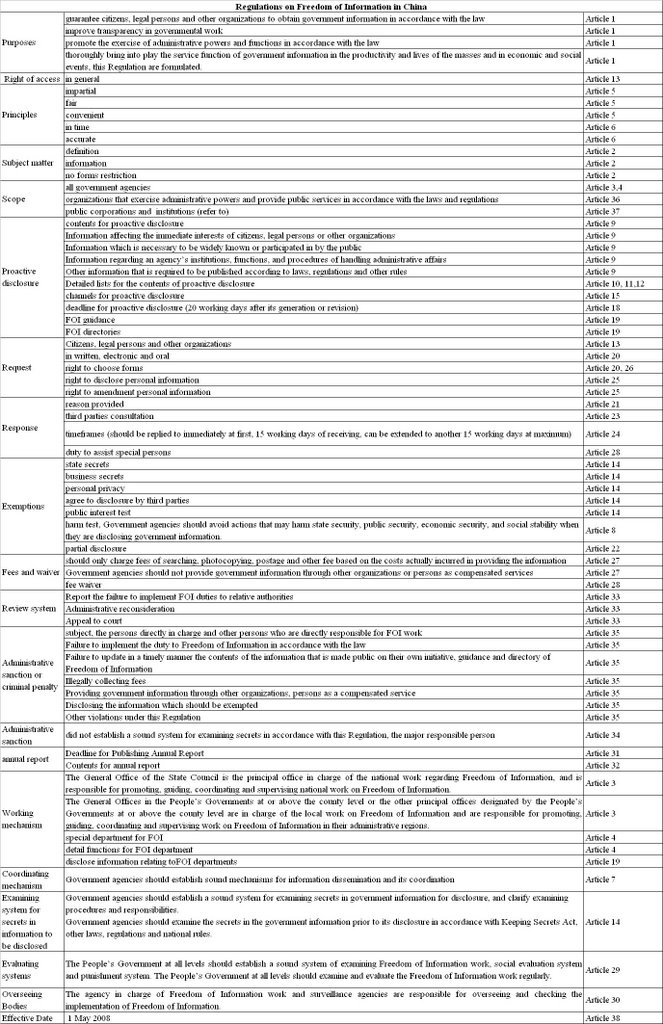
In 2007, after a five-year consideration period, Chinese central government introduced the Regulations of the People's Republic of China on Open Government Information, which came fully into force on 1 May 2008.
Four main objectives of the Regulations can be described as follows:
1) Guaranteeing citizens, legal persons and other organizations to obtain government information legally
2) Improving the degree of transparency in governmental work
3) Promoting the exercise of administrative powers and functions in accordance with the law
4) Fully fulfil the service function of government information to the people’s production, life, economic and social activities
Requests may be submitted either orally or in written form and no grounds are required for the request. Government agencies should give a response immediately to the requesters. If a response cannot be given immediately, government agencies should reply to the requesters in 15 working days after they received the requests.
Submitting a request is itself free of charge, and fees for access should be limited to the cost for searching, photocopy, postage and others based on the costs actually incurred in providing the information. However, requesters may be asked to provide a reason for asking for the information, and while the definition of an acceptable reason is broad, the fact that the provision exists (and didn’t under previous local government FOI) means the Regulations fail to meet internationally-recognised best practice.
The Regulations require the government agency to publish an annual FOI report before 31 March of each year. The annual report should include particulars of proactive disclosure, requests received, granted, refused, appealed, fees charged and waived, and problems confronted and recommendations for reform.
The Regulations include much broader requirement for proactive disclosure than FOI laws elsewhere. A minimum standard has been set to oblige government departments to firstly create/collate, and then actively release information (within 20 days of the information being generated or changed). Information that satisfies any of the following criteria is required to be released:
Information that involves the vital interests of citizens or organisations
Information that ‘needs to be extensively known’ or participated in by the public
Information that shows the structure, procedures and functions of government agencies
Recent developments
According to Piotrowski et al., major obstacles for FOI in China include improper designation of the supervision office, delay of the catalogues and detailed guides for FOI implementation, and inadequate facilities and equipment for the public to access information. Xiao cites broad and vague exemptions as another failing.
On data protection sector, the new Tort Liability Law, which came into force 1 July 2010, introduced citizen’s right to privacy in the Chinese legal framework for the first time.
How is FOI working?
State level
Government agencies publish their annual FOI reports quite regularly, but there is no comprehensive FOI report at national level. The closest thing so far for comprehensive national FOI report is the report of the General Office of the State Council, which covers particulars of proactive disclosure, FOI training and survey. The report does not deal with particulars of access requests.
However, individual agencies have published their FOI reports. In 2008, of the ministries and commissions under the State Council, the National Development and Reform Commission received the largest number of requests, 411. Between the date of commencement of the FOI Regulations on 1 May 2008 and 31 December 2008, a total of 890 requests were received by the 22 State ministries and commissions. According to these reports, there was only 12 cases of administrative reconsideration of agency decisions on access request and 1 FOI lawsuit in 2008. Of agencies outside the State Council, most requests in 2008 were aimed at the State Administration for Industry and Commerce, 2778.
According to Ben Wei, Chinese citizens use FOI for information
to examine whether or not their interests had been violated (enterprise restructure, house demolition and land use)
to better understand their personal legal matters (pending criminal and civil cases)
to learn more about how government agencies processed their business affairs
to solve their outstanding issues with the government, such as housing takeovers before and during the Cultural Revolution
During the first six months after implementation of the FOI Regulations, legal professionals were the most frequent requesters in China.
Province level
At the province level figures of FOI requests received and applications made for reconsiderations have been completely different. Between 1 May and 31 December 2008, there was a total number of 88,056 information requests received by the 15 provinces. Most requests was received by Yunnan province (17,955), whereas in Gansu province only 6 applications were made. In addition, in Shanghai only (where FOI has been in force since 2004), 683 applications were made in 2008 for administrative reconsiderations, 100 more than the total figure of 2004-2007.

Papers Probe Drivers of Transparency in China

24 May 2011
http://www.freedominfo.org/2011/05/papers-probe-drivers-of-transparency-in-china/

Emerging transparency in China and what explains it was the topic of two papers presented at The First Global Conference on Transparency Research held May 19-20 at Rutgers University-Newark, N.J. (See overall report in FreedomInfo.org.)
In “the first empirical study uncovering the drivers of fiscal transparency in China,” Liang Ma and Jiannan Wu of Xi’an Jiaotong University, ended with several practical observations. “Specifically, governments need to arrange essential organizational, personnel, and records management resources for the open government information policies.” they wrote.
In addition:
Endorsement and support from top leaders are very important for fiscal transparency, and the central government could advance government transparency through more effective controls and incentives on local officials.
Finally, our findings demonstrate that economic openness and market-oriented reform contribute strongly to fiscal transparency, and deepening the institutional reforms and encouraging economic openness may benefit government transparency in long run.
Another paper on China stated that “reform is not a result of economic development and a fight against corruption, but an outcome of improved information flow resulting from social, political, legal and economic factors.”
This explains why China “has adopted a push model of FOI legislation stressing proactive disclosure,” according to Weibing Xiao, a lecturer at the School of Economic Law at the Shanghai University of Political Science and Law.

Saturday, May 21, 2011

Professor John Taylor's Comments on My Article within Information Polity

The papers in this edition provide further testament to the international standing of Information Polity. This edition contains five papers, authored by academics from five different countries: China, Costa Rica, Slovenia, Norway, and Turkey. In the first of these Weibing Xiao argues that the expansion of ‘information pathways’ in China, brought about by the widespread and growing adoption of new media, has brought the Chinese government intomore receptivemode in terms of the adoption and acceptance of ‘freedomof information’. The necessity of releasing information during physical disasters and social and political crises has broadened to a more general acceptance that much more information can and should be made available to Chinese citizens. Citing a number of Confucian aphorisms such as ‘the common people may be made to follow, but may not be made to know’, Weibing Xiao explains the long history of State secrecy in China as a consequence of the influence of the greatest of Chinese philosophers. The movement towards Freedom of Information sat in stark opposition to a philosophical conviction that the common people are best protected from learning about issues of governance including crises. Now in the era of new media uptake, as Weibing Xiao explains, the release of information hitherto kept secret works as a necessary social corrective to what emerges as forms of ‘rumour’. Rumour, it is now argued, is potentially far more damaging to governance of the nation State than more open flows of information. Additionally, and in a more general sense, flows of information are more developed in China now both amongst citizens and between them and government. Thus there is an environment in China that is moving strongly towards the release of information rather than its secretive capture and management.

Sunday, May 8, 2011

Access requests received by the Shanghai Government from 2008 to 2010


Between 2008 and 2010, Shanghai government agencies received a total of 33,167 access requests. The chart shows the total number of requests for each year. In 2009 a total of 11,733 requests were received, an increase of 2,385 from 2008. The requests in 2010 (12006)reached the second highest annual figure, although it was still a little bit lower than that in 2005 (12465).

Saturday, May 2, 2009

Chinese State Agencies' Responses to FOI requests


Among the 22 state central agencies’ annual reports, 8 agencies’ reports did not provide the particulars of responses to information requests. The details in 14 agencies’ annual reports were very clear with the exception of the National Development and Reform Commission’s report. The 14 annual reports indicated that rare information requests were rejected for the reason that the information sought fell into the statutory exemptions set out in the FOI Regulations. A few requests were refused due to ‘other reasons’ which include withdrawal of requests, petitions and others.

Note: the Ministry of Civil Affairs may have made an error in calculating the total.

Friday, May 1, 2009

Only one applicant took a state central agency to court in 2008


According to the 22 central agencies' annual reports, there is only 1 FOI lawsuit. The number of applications for administrative reconsideration is much higher than that of lawsuit, but the figure is still very low, only 12. For detail information, see the statistics.

Wednesday, April 29, 2009

Another two provincial FOI annual reports are available now


Jilin and Hainan Province published their FOI annual report on their government websites. The number of access requests came as a surprise. Government agencies in Jilin Province located in Northeast of China,received 45992 requests, the largest number among other provinces in 2008. In contrast, government agencies in Hainan Province based in South of China received none of requests in the previous year. This is quite different from their climate. Jilin is a cold climate, and Hainan is a hot one.

Tuesday, April 28, 2009

Another 31 State Central Agencies' FOI Annual Reports are Available in China


Another 31 state central agencies’ FOI annual reports are available now. According to these 31 annul reports, the State Administration for Industry and Commerce received the largest number of requests in 2008, amounting to 2778. Among these 31 state agencies, 2 agencies’ total number of requests is not available, and other two agencies’ figure of information requests are inaccurate as it includes the number of consultation.Three agencies did not receive any requests in the previous year. See the table for more detail.

Note: will provide the details of agencies' decisions on information requests in the future.

Shanghai: a key local forerunner of FOI in China

In 2009, the Shanghai government was committed to making it one of the regions with the highest transparency across the country. It determines to establish a push model of FOI which takes information requests as a last resort. The Hunan government, which is based on a comparatively developing area, is also keen to the push or proactive disclosure way, but it acknowledges that this way can help it focus more on other more urgent tasks in its locality.

Source:Suggestions on Further Strengthening the Work of FOI in Shanghai No20 [2009]of the Shanghai Government; The Hunan Government, Freedom of Information Regulations 2007 Annual Report 2008.

Friday, April 24, 2009

FOI Annual Report for 27 ministries and commissions under the State Council


There are 27 ministries and commission under the State Council. 5 Ministries’ FOI Annual Reports have not yet available. Between the date of commencement of the FOI Regulations on 1 May 2008 and 31 December 2008, a total of 890 requests were received by the 22 ministries and commissions. The National Development and Reform Commission received the largest number of requests in 2008, amounting to 411. Agencies’ share of requests falls sharply after the top one. Only the Ministry of Justice did not receive any FOI requests in the past 2008.

Note: will provide other agencies under the State Council in the immediate future

Wednesday, April 22, 2009

Governmental Responses to FOI Requests in China


The 15 provincial FOI annul reports show that only a small number of information requests fell into the category of the statutory exemptions. About 10% and 5 % requests were rejected due to the statutory exemptions in Beijing and Shanghai respectively, representing the two largest one among other provinces. Most of requests were refused because of the reason that the information sought did not exist or was not under the possession of the agency.

Tuesday, April 21, 2009

The Number of FOI Review in China


Between 1 May 2008 and 31 December 2008, 881 applications were made for administrative reconsideration or internal review of agency decisions on access requests in 17 provinces. 307 FOI lawsuits were lodged with the Chinese courts in these provinces. Most of applications for administrative reconsideration and lawsuits occurred in Shanghai, 683 and 258 respectively. The number of complaints about FOI matters was only 26.

88,056 information requests received by the 15 provinces in China


Among 17 provincial governments’ FOI annual reports, only 15 reports provided particulars of the use of FOI legislation. The Sichuan government has had a passionate interest in implementing FOI legislation, proactively disclosing much more documents than other provinces in 2008, amounting to 27,662,645. Three provinces received more than 10 thousand access requests, including Yunnan (17955), Shangdong (16368) and Henan (15749). There was an extremely low use of FOI legislation in Gansu province, only receiving 6 applications. There were 88,056 information requests received by the 15 provinces between 1 May 2008 and 31 December 2008.

Friday, April 17, 2009

FOI annual report in China at the province level (2008)


By 17 April 2009, there were still 5 provinces, including Shanxi, Hebei, Xinjiang, Qinghai and Guangxi which had not publicized their FOI annul reports on the Internet. While 7 provinces made their FOI annual reports public, they only produced a specific report which only covers details of the General Offices of the Provincial Government. The Guangdong government, a pioneer city which adopted the first FOI kind legislation in China in 2002, came as a surprise because it did not compile a general annual report for the whole province. The rest (19) provincial governments generated their annual report covering particulars of all departments in their own administrative areas.

More details about the use of FOI legislation will be available in the coming future.

Note: Red circle for a general annual report; Blue circle for a special annual report. The rest, excluding Hong Kong, Macao and Taiwan, without circle.

Monday, April 13, 2009

The first FOI Case supported by the Chinese courts

After the FOI Regulations went into effect, Xu Jianguo, a Beijing lawyer, filed a request dated 1 May 2008 to the Huangzhou District Bureau of Transport for some proactively disclosed information concerning this Bureau’s structure, function and working procedures. The Bureau did not answer Xu’s request, and thus he brought it to court on 2 June. The court judged that the Bureau’s mute refusal was illegal, and this judgment became the first FOI lawsuit which was supported by the court after the FOI Regulations went into effect in China. The Hubei Provincial Legislative Affairs Office thus issued a bulletin to inform all government agencies of this non-compliance, calling on government agencies to comply with the Regulations. One of the officials in this Office questioned ‘why should the agency not disclose the information until the masses take you to court?’ This bulletin may create positive effects on enforcement of FOI legislation.

source: Doudou Tian, ‘The Government Agency Lost its FOI Lawsuit for the First Time’ People’s Daily (Beijing) 10 October 2008, 10.

The first FOI case supported by administrative reconsideration agencies

A significant case occurred after the FOI Regulations went into effect. On 26 May 2008, Xu Yaofang and 67 other villagers filed a request to the Yuyao Government in Zhejiang Province for information regarding land transfer in order to know more details about the transfer of approximately half of the total lands of their village. After they did not get any response from the Yuyao Government, they lodged an application for administrative reconsideration with the Ningbo Government which required the Yuyao Government to handle this request in accordance with the FOI Regulations.

Source: Junxiu Wang, ‘68 Villagers in Yuyao City of Zhejiang Province Win their FOI Lawsuit’ China Youth Daily (Beijing) 10 October 2008, 6.

Friday, April 3, 2009

A significant increase in the number of FOI lawsuits in Shanghai


The number of administrative reconsideration and lawsuits has increased significantly during the last five years. In 2008, 683 applications were made for administrative reconsideration of agency decisions on access requests, 100 more than the total figure of the last four years (2004-2007). There were 258 applications for court review of decisions concerning access requests, 1.5 times as many as the total number of the previous four years (2004-2007). The number of complaints about FOI matters received by government agencies administering FOI work was not available in the 2008 report. However, previous reports indicated that this number should be much higher than that of last year. The 2008’s annual report also showed that government agencies spent 57.5 thousand yuan (about $84 thousand) on litigation. The improvement of public awareness of FOI legislation may have contributed to this significant increase.

Thursday, April 2, 2009

Shanghai: the Significant Decrease of the Percentage of Revoking Agencies' Original FOI Decisions


Under the Shanghai FOI Rules, an applicant who is dissatisfied with the decision of an agency on his or her initial FOI request can apply to the next higher agency for administrative reconsideration. In 2008, the Legislative Affairs Office of Shanghai received 365 applications for administrative reconsideration, and accepted 352 applications. This Office made 350 decisions on administrative reconsideration, with 28 (8%) of those decisions reversing the original decisions, decreasing 3.3% from last year (11.3%). During the last five years, the percentage of revoking the original decisions has fallen dramatically from 46.2% (2004) to 8% (2008), indicating that FOI general officials have improved their professional knowledge about the Rules and quality of service for access requests.

The Comparison of the Last Five Years of Information Requests in Shanghai


Between 1 May 2004 (the date of commencement of the Shanghai FOI Rules) and 31 December 2008, Shanghai government agencies received a total of 44,670 access requests. The following Chart shows the total number of requests for each year since the commencement of the FOI Rules in 2004. It should be noted that in 2004 the FOI Rules operated for seven months only. In 2008 a total of 9,388 requests were received, an increase of 2,903 (44.77%) from 2007. The requests in 2008 reached the second highest annual figure, although it was still much lower than that in 2005 (12465).