Google

Thursday, May 1, 2008

The China's FOI Regulations Go into Effect Today

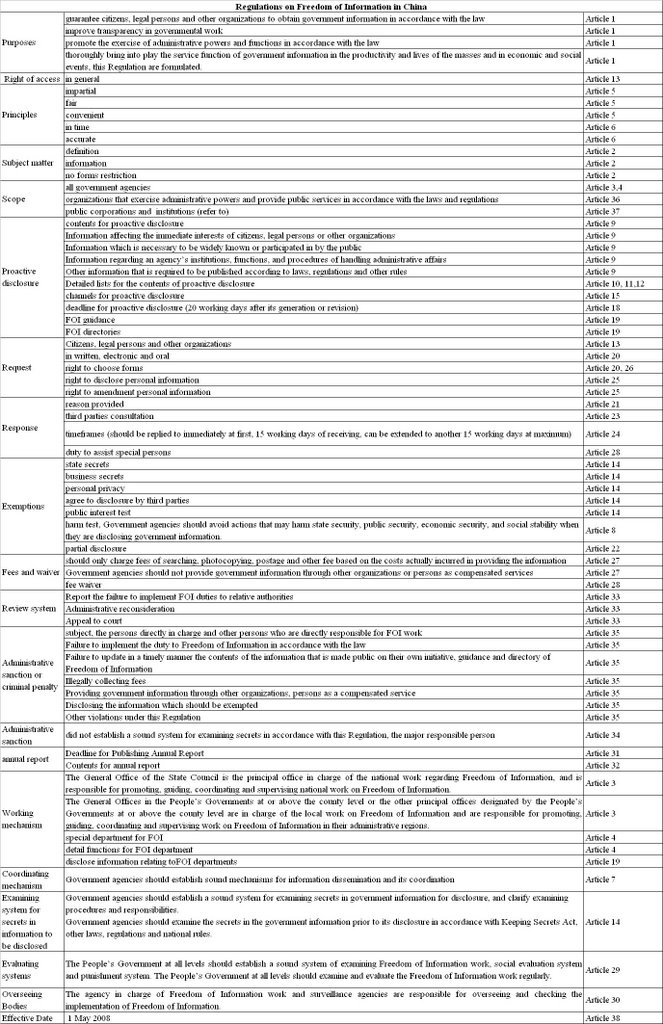
After a year's preparation, the China's FOI Regulations go into effect today. The General Office of the State Council also promulgated its Several Suggestions on Implementation of the China’s Freedom of Information Regulations on 29 April 2008.[1]


[1] The General Office of the State Council, Several Suggestions on Implementation of the China’s Freedom of Information Regulations Guobanfa[2008]No.36.

"> " title="permanent link">#

An Access Request: A Purpose is Needed

One of international best practices is that anyone should be available to exercise the right to know without any grounds or legal interests. Most FOI laws do not require requesters to provide reasons for their request with the exception of the Italian legislation.[1] Iyer argues that an ideal right to know allows anyone to request information without having to show a reason why they are asking for that.[2] This requirement is slightly unclear under the China’s FOI Regulations. The Regulations enables citizens, legal persons or other organizations to request information held by government agencies in accordance with their needs in business, daily life, research or other special needs (Article 13). It seems that the purpose for information requested is required. Horsley expresses her concern that government agencies might refuse access requests with an excuse that information requested does not meet with requesters’ special needs.[3]Her concern is right after the promulgation of Several Suggestions on Implementation of the China’s Freedom of Information Regulations on 29 April 2008.[4] This document clearly states that government agencies may refuse to provide the information requested if it is no relevance to a requester’s special needs (production, daily life, scientific research or the like). In Shanghai, the purpose for a request is required to be provided before sending an access request; however, in practice, Shanghai government agencies have not considered this as a reason to refuse access requests.[5]


[1] Article 22 (1) of the Law on Administrative Procedure 1990 requires that those who request information should have a ‘direct, practical, and actual interest based on a legally regulated case in relation to the document for which access is required’.

[2] Venkat Iyer, Freedom of Information: Principles for legislation (2000) UNPANat 13 November 2006.

[3] Jamie Horsley, China Adopts First Nationwide Open Government Information Regulations (2007) Freedom of Information Organizationat 28 August 2007.

[4] The General Office of the State Council, Several Suggestions on Implementation of the China’s Freedom of Information Regulations Guobanfa[2008]No.36.

[5] Chen Zhong and Xiao Lu, Shanghai Issued its New FOI Rules (2008) Caijing <>at 1 May 2008.

"> " title="permanent link">#

Tuesday, April 29, 2008

China is ready for entering a new era: a more transparent society

After a year’s preparation, the China’s “landmark” FOI Regulations will go into effect the day after tomorrow. However, Chinese citizens will welcome their three days’ holiday for celebrating May Day. It seems that the actual operation of these Regulations will be postponed to 4 May, the Youth Day in China. To be frank, China is a newcomer to implement its access legislation. While there are many problems that will significantly influence the implementation of this legislation, we still highly expect that it will achieve success. Nevertheless, the adoption and implementation of access legislation indicates that China is ready for entering a new era: the developing of a more transparent society.

"> #

Tuesday, April 8, 2008

The number of requests received during the last four years in Shanghai


Between 1 May 2004 (the date of commencement of the Shanghai FOI Rules) and 31 December 2007, Shanghai government agencies received a total of 35,282 access requests. The following Chart shows the total number of requests for each year since the commencement of the FOI Rules in 2004. It should be noted that in 2004 the FOI Rules operated for seven months only. In 2007 a total of 6,485 requests were received, a decrease of 1,048 (13.91%) from 2006, and 5,980 (47.97%) from 2005. The total number in 2007 is surprisingly less than that in 2004 (only 7 months’ operation). What causes this decrease is unknown at this stage.

"> " title="permanent link">#

The Comparsion of 2006 and 2007's access requests in Shanghai

The number of requests in 2007 is 6485. This is a decrease of 13.91% compared to 2006. 6852 and 5893 requests have been responded in 2006 and 2007 respectively. The percentage of full-disclosure responses in 2007 is lower than that of last year (compared with 67.61% in 2007 and 75.06% in 2006). However, the percentage of refusals increases from 20.48% in 2006 to 27.32% in 2007, and more refusals fall within the scope of the six stipulated exemptions (compared with 25.34% in 2007 and only 13.40% in 2006). It indicates that the quality of requests or the public bodies’ capacity to handle FOI requests is increasing.

"> " title="permanent link">#


The 2007's FOI Annual Report in Shanghai


Source: Shanghai Municipal Informatization Commission Translated by author

Shanghai government agencies received 6485 requests in 2007. 5893 requests were determined in this year, of which, 3984 (67.61%) were granted in full, 299 in part (5.07%) and 1610 (27.32%) wholly refused. Of these refusals, 539 were refused on the basis of wrong agencies approached, 490 were refused due to the non-existence of information, and 255 were rejected because of unclear requests. The information requested by 44 applicants did not fall into the definition of information under the Shanghai FOI Rules. Only 511 requests fell into six legitimate FOI exemptions. The exemption of state secrets has been frequently claimed by government agencies during this year. The rest (103) were refused because of “other reasons”, such as withdrawals from requesters and non-FOI requests (petition letters). The 2007’s annual report has the statistics of information requested that doest not fall into the definition of information under the Shanghai FOI Rules.

"> #

Monday, January 21, 2008

Training in FOI in Shanghai

In Shanghai, regular training in FOI seems to be safeguarded to a certain degree. In 2004, nearly 300 government officials attended the training program organized by the Municipal Administrative Institution. During this year, about 3000 government officials from districts and counties received similar training. Such training has been conducted twice in 2005. In 2006, more than 300 government officials received professional training in FOI in June and November respectively. The Shanghai Cadres Online Learning City set up a special course for FOI after 2006. This made FOI become an internal part of the knowledge system of the Shanghai Municipal officials’ education and training.


The US got its new improved version of FOI legislation

Taken from Freedom of Information Organization

Washington, DC, January 18, 2008 - Two weeks after President Bush signed landmark legislation to reform the Freedom of Information Act (FOIA) the first public discussion between officials and openness advocates was held this week, according to a new Web posting on freedominfo.org. The meeting focused on key provisions of the new law, including the creation of the Office of Government Information Services (OGIS) to function as a FOIA ombudsman, the availability of attorneys fees for FOIA requesters, penalties for agency delay, and changes to the definition of "news media." The law, which passed both houses of Congress in December with bipartisan support after several years of negotiation, aims to fix some of the most persistent problems in the FOIA system, including excessive delay, lack of responsiveness, and litigation gamesmanship by federal agencies.

Training in FOI in China

Before the effective date of the FOI Regulations, the Office of Legislative Affairs under the State Council conducted six training sessions between October and December 2007 and trained about 3,000 attendees coming from a wide range of government agencies.

"> " title="permanent link">#

Saturday, December 29, 2007

FOI Monthly Report in Shanghai (November)

Taken from Shanghai Informatization Commission and translated by Ben Wei

Shanghai government agencies received 601 requests in November 2007. 413 requests (together with requests carried forward from last month) were determined in this month, of which, 205 (50%) were granted in full, 29 in part (7%) and 179 (43%) wholly refused. Of these refusals, 38 were refused on the basis of wrong agencies approached, 57 were refused due to the non-existence of information, and 35 were rejected because of unclear requests. The information requested by 21 applicants did not fall into the definition of information under Shanghai FOI Rules. Only 17 requests fell into six legitimate FOI exemptions. Exemptions of state secrets and deliberations have been frequently claimed by government agencies during this month. The rest (11) were refused because of “other reasons”, such as withdrawals from requesters and non-FOI requests (petition letters).

"> " title="permanent link">#

FOI Monthly Report in Shanghai (October)

Taken from Shanghai Informatization Commission and translated by Ben Wei

Shanghai government agencies received 597 requests in October 2007. 528 requests (together with requests carried forward from last month) were determined in this month, of which, 359 (68%) were granted in full, 16 in part (3%) and 153 (29%) wholly refused. Of these refusals, 33 were refused on the basis of wrong agencies approached, 51 were refused due to the non-existence of information, and 18 were rejected because of unclear requests. The information requested by 8 applicants did not fall into the definition of information under Shanghai FOI Rules. Only 20 requests fell into six legitimate FOI exemptions. Exemptions of state secrets and deliberations have been frequently claimed by government agencies during this month. The rest (21) were refused because of “other reasons”, for example non-FOI requests (consultation and petition letters).

"> " title="permanent link">#

FOI Monthly Report in Shanghai (September)

Taken from Shanghai Informatization Commission and translated by Ben Wei

Shanghai government agencies received 523 requests in September 2007. 458 requests (together with requests carried forward from last month) were determined in this month, of which, 274 (60%) were granted in full, 24 in part (5.5%) and 158 (34.5%) wholly refused. Of these refusals, 61 were refused on the basis of wrong agencies approached, 24 were refused due to the non-existence of information, and 41 were rejected because of unclear requests. The information requested by 12 applicants did not fall into the definition of information under Shanghai FOI Rules. Only 16 requests fell into six legitimate FOI exemptions. Exemptions of state secrets and deliberations have been frequently claimed by government agencies during this month. The rest (8) were refused because of “other reasons”, such as withdrawals from requesters and non-FOI requests (petition letters).

"> " title="permanent link">#

Tuesday, December 4, 2007

The Civil Servant Law in China

China's Civil Servant Law was adopted on 4 April 2005 and went into effect on 1 June 2006. This law requires a civil servant to protect the secrets relating to their work (Article 12) and not to disclose any work secrets (Article 54). However, this law does not define work secrets. In practice, this undefined term could mean everything concerning government operations, and this will significantly encourage government officials in advocating secrecy. [1] Regulations on Imposing punishment on Civil Servants in the Administrative Branch were adopted by the State Council on 29 April 2007, and went into effect on 1 June 2007. Civil servants are liable to a variety of administrative sanctions, such as warning, demerit record, heavy demerit record, demotion, dismissal and discharge, for their disclosure of state and work secrets resulting in various adverse consequences (Article 26).

While work secrets are not formally provided for under China's FOI Regulations, it is still necessary to clearly define this broad term in order to avoid its adverse effect on FOI.


[1] Hanhua Zhou, Draft for FOI Regulations (1st ed. 2003) 112.

"> " title="permanent link">#

Tuesday, November 6, 2007

Public interest test in three countries' FOI legislation

A general public interest test was adopted in New Zealand FOI legislation, while only a special public interest was adopted in those of Australia and China. In New Zealand, the general public interest test seems to be mandated in respect of every release. In most cases a balancing process is required only with a few exceptions. [1] A special public interest test exists in Australia and China. In Australia, a pubic interest test is applied to five exemptions: relations with states, financial interests of the Commonwealth, internal working documents, financial documents, and documents related to operations of agencies. However, in China, this test is only applied to privacy and trade secrets exemptions.


[1] Judith Aitken, ‘Open Government in New Zealand’ in Andrew McDonald and Greg Terrill (eds) Open Government: Freedom of Information and Privacy (1998) 117, 124.

"> " title="permanent link">#

The comparative study of FOI is needed

According to Snell, the comparative study of FOI is ‘relatively unexplored’ around the world.[1] Snell also calls for ‘[t]here is an urgent need for academics, postgraduates, government officials and NGOs to develop comparative studies in this area which include, but extend beyond, singular case studies or collections of case studies’. [2] However, Snell examines that few scholars have created good comparative tools to help ‘cross-jurisdictional analysis’ of a variety of FOI development around the world.[3] Some scholars did a great job in this area. Roberts[4] and Snell[5] developed an administrative compliance model to analyze the implementation of FOI legislation. Lidberg created a monitoring tool to examine five countries’ gap between the promises of FOI legislation and the real practices.[6] The Open Society Justice Initiative also developed an Access to Information Monitoring Tool which provides a way of measuring government transparency and tracking progress in fourteen countries’ implementation of FOI laws. [7] However, these studies miss each country’s history or culture out of their analysis.


[1] Rick Snell, ‘Using Comparative Studies to Improve Freedom of Information Analysis: Insights from Australia, Canada and New Zealand’ (Paper presented at the 6th National and 2nd International Congress on the Right to Information, Mexico, 8-11th November 2005) 19.

[2] Rick Snell, ‘Is there a Role for Comparative Freedom of Information Aanlysis?: Part 1’ (2004)113 Freedom of Information Review 57, 60.

[3] Rick Snell, ‘Freedom of Information Practices’ (2006) 13 Agenda 291, 300.

[4] Alasdair Roberts, Limited Access: Assessing the Health of Canada’s Freedom of Information Laws (1998) Canadian Newspaper Association at 17 November 2006.

[5] Rick Snell, ‘Administrative Compliance-Evaluating the Effectiveness of Freedom of Information’ (2001) 93 Freedom of Information Review 29.

[6] Johan Lidberg, ‘Keeping the Bastards Honest’ – The Promise and Practice of Freedom of Information Legislation (D Phil Thesis, Murdoch University, 2006).

[7] Open Society Justice Initiative, Transparency & Silence: A Survey of Access to Information Laws and Practices in 14 Countries (2006) Open Society Institute & Soros Foundations Network< http://www.soros.org/resources/articles_publications/publications/transparency_20060928 >at 15 November 2006.

"> " title="permanent link">#

Monday, November 5, 2007

Criticism of disclosure of law in ancient China

As a result, in BC 536, laws were officially published for the first time on a Ding (a vessel) by Chan Zi in the Zheng Kingdom. Xiang Shu strongly disagreed with Chan Zi on the disclosure of laws and sent a letter to Chan Zi to criticize his decision. He identified mainly four factors against the disclosure of law: the prestige of the rulers would be diminished by such disclosure; the masses would argue with each other after the disclosure of law; the law could not be considered in detail and resultant injustice; law was originally published for the purpose of limiting tyrants’ power.Chan Zi ignored Xiang Shu’s criticism and replied to his letter that he published the law in order to save the kingdom.

Note: Qiuming Zuo, Zuo Zhuan—Zhao Gong Liu Nian (2000)Guoxue at 14 May 2007.

"> " title="permanent link">#


Saturday, November 3, 2007

Political support for FOI

The political report of the 16th National Congress of the Communist Party of China (NCCPC) in 2002 recognized that the importance of transparency and required to promote open government affairs around the country.[1] The political report of the 17th NCCPC in 2007 further required to improve the open administrative system in various areas and increase transparency in government work and recognized that ‘[p]ower must be exercised in the sunshine to ensure that it is exercised correctly’.[2]

"> " title="permanent link">#


[1] Jiang Zeming, Build a Well-off Society in an All-Round Way and Create a New Situation in Building Socialism with Chinese Characteristics Jiang Zemin’s Report at 16th Party Congress (2002) Xinhuanet<>at 26 October 2007.

[2] Hu Jintao, Hold High the Great Banner of Socialism with Chinese Characteristics and Strive for New Victories in Building a Moderately Prosperous Society in All Respects—Hu Jintao’s Report at 17th Party Congress(2007) People.com<>at 26 October 2007.

Monday, October 29, 2007

Disclosure of Law in Ancient China

In BC 536, law was officially published for the first time on a Ding (a vessel) by Chan Zi in the Zheng Kingdom.

In BC 513, Zhao Yang in the Jin Kingdom also published the criminal law on a Ding.

The Qin Dynasty clearly explained terms and purposes of the criminal law in a book, titled Frequently Asked Questions about Criminal Law. Meanwhile, Emperor Qin Shi Huang required the public to be educated about criminal law (Yi Fa Wei Jiao), and government officials to promulgate criminal law (Yi Li Wei Shi).

Emperors in the following dynasties basically disclosed their law to the public, although it is difficult to find evidence of the disclosure of Han Law (Han Lv) in the Han Dynasty.

However, in the Jin Dynasty (265-420), Emperor Jin Wu Di published Xin Law (Xin Lv) in 267.

In the Tang Dynasty, Emperor Tang Tai Zong published Tang Law in 637. Emperor Tang Gao Zong promulgated Explanations of Tang Law as a new law in 654. Emperor Tang Xuan Zong published an amended Tang Law and produced 130 copies in 737.

In the Song Dynasty, Emperor Song Tai Zu published Song Criminal Law in 963, and this law was first published by using woodblock printing.

In the Ming Dynasty, Emperor Ming Tai Zu promulgated Ming Criminal Law (Ming Da Gao) in 1385. Emperor Ming Tai Zu required each family to be held a cope of Ming Criminal Law. The person who committed crime and should be punished by banishment or under this punishment in accordance with the law could be given a directly lighter punishment if his or her family had a cope of Ming Criminal Law. Accordingly, Ming Criminal Law became the most widely distributed and well-known law in ancient China. In 1397, Emperor Ming Tai Zu published another version of Criminal Law (Da Ming Lv).

In the Qing Dynasty, the Qing Law stipulated that any law related to crime should be disclosed to the public and required government officials to be familiar with law.

"> " title="permanent link">#

Chinese Legalists' Views about Disclosure of Law

In the Spring and Autumn Dynasties, many legalists favoring rule of law started to promulgate their theory about law and gained support from the rulers. Feizi Han argued that ‘law should be known by the public’. Yan Shang asserted that ‘law should be easily understood and known by the public’. He also required officials in charge of legislation to promulgate law and answer enquiries from the public in order that everyone could understand law. If the public understood law, then officials could not treat the public illegally.

"> " title="permanent link">#

Wednesday, October 17, 2007

New Zealand and Australia experience a different path in FOI development

New Zealand and Australia experience a different path in FOI development, although both countries have a lot in common, such as ‘long term, stable liberal democracies with a strong Westminster system that heavily favored official secrecy’.[1] The path of New Zealand is a harmony one in which most of government officials and the public support this reform, while the path of Australia is a conflict one in which government’s attitude towards transparency is different from the public. The reasons behind this divergent path in Australia and New Zealand deserve more analysis.


[1] Rick Snell, ‘Freedom of Information Practices’ (2006) 13 Agenda 291, 293.

"> " title="permanent link">#

The advanced technology dramatically decreases the cost of obtaining information

The advanced technology dramatically decreases the cost of obtaining information. Internet makes the flow of information cheaper, quicker and more convenient than before. At the end of 2005, there are 11,995 government websites. 81.1% government authorities at and above county level have established their websites. 96.1% government authorities directly under the State Council have established their websites on the internet. The percentage for government authorities at provincial and county level established websites is 96.1% and 77.7% respectively. Government websites become one of the most important methods for information flow between government and the public. In addition, the number of telephone users increased dramatically from 0.23 billion in 2000 to 0.74 billion in 2005. There are 30 mobile phones per 100 persons in 2005; this number is only 7 in 2000. 95.29% people have television in 2005. The number of internet users is up to 137 million in January 2007, accounting for about 10% of the China’s population (about 1.3 billion).

"> " title="permanent link">#

China: FOI legislation is considered as one of the useful methods preventing corruption

FOI legislation is considered as one of the useful methods preventing corruption because ‘sunshine is the best disinfection’. Hanhua Zhou argues that ‘FOI is one of the best methods to prevent corruption from its source’. Some officials from the Legislative Affairs Office of the State Council, argues that ‘FOI is one of the most important mechanisms to establish a clean government’. Xueshan Yang who is the deputy director of the Informatization Office of the State Council asserts that FOI is the most effective killer of corruption. Qiong Zhang, deputy director of the Legislative Affairs Office of the State Council, explained in a news conference that FOI benefited corruption-preventing from its roots.

"> " title="permanent link">#

Wednesday, October 10, 2007

Australia Talks FOI

Taken from Open and Shut blog run by Peter Timmins

Australia Talks on Radio National included a segment on "Freedom of Information and Digital Policy" featuring Rick Snell of the University of Tasmania and Michael McKinnon, Freedom of Information Editor Channel 7. It provided a good overview of some of the current problems and issues regarding record keeping.

"> " title="permanent link">#