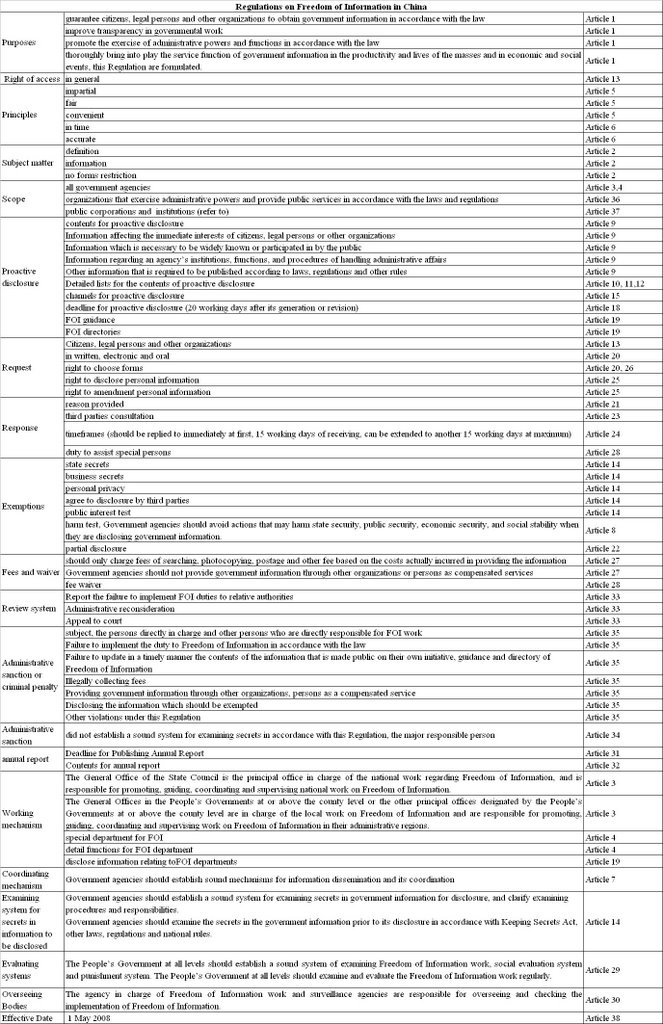
Taken from UCL, Constitution Unit, see http://www.ucl.ac.uk/constitution-unit/research/foi/countries/china
Although the context of Freedom of Information in People’s Republic of China is arguably unique, the key issues surrounding the implementation of FOI regime mirror those in other countries. This is because, it is argued, China’s regime alongside many other new regimes derives from the recent international tendency to implement transparency, rather than from a long-standing culture of liberal democratic tradition. Instead of being focussed on filling an accountability deficit and enhancing democracy, the concept of Chinese FOI is from the viewpoint of enhancing information flow, a more effective bureaucracy and a drive to fight corruption.
Weibing Xiao also argues that China’s model of transparency emphasises proactive disclosure (‘ push model’) over citizen access (the ‘pull model’) which is in keeping with technological advances. China’s state agencies now have websites, and official spokespeople. Further, China’s massive population could potentially overwhelm the state bureaucracy with requests; proactive disclosure ‘may have reduced’ the use of citizen-initiated requests. Lastly, citizen journalists and alternative news sources have played key roles in reporting crises like the Sichuan earthquake and the tainted-milk scandal. ‘Government officials will play huge financial and public-trust costs for concealing information.’ They realise damaging rumours can be quashed with reliable official information release.
History
During China’s general re-alignment in the 1980s under Deng Xiaoping’s leadership, political endorsement of village-level decision making led to Openness of Village Affairs legislation. This eventually led to implementation of FOI, namely the Regulations of the People’s Republic of China on Open Government Information.
Although the Regulations came into force in 2008, there had already been provincial FOI, with Guangdong as the first Chinese province to introduce an FOI regime in 2002. Particularly active has been the province of Shanghai, where Shanghai Municipal Provisions on Open Government Information was implemented in 2004 and which has published monthly FOI reports with detailed statistics on number of requests.
Regulations
In 2007, after a five-year consideration period, Chinese central government introduced the Regulations of the People's Republic of China on Open Government Information, which came fully into force on 1 May 2008.
Four main objectives of the Regulations can be described as follows:
1) Guaranteeing citizens, legal persons and other organizations to obtain government information legally
2) Improving the degree of transparency in governmental work
3) Promoting the exercise of administrative powers and functions in accordance with the law
4) Fully fulfil the service function of government information to the people’s production, life, economic and social activities
Requests may be submitted either orally or in written form and no grounds are required for the request. Government agencies should give a response immediately to the requesters. If a response cannot be given immediately, government agencies should reply to the requesters in 15 working days after they received the requests.
Submitting a request is itself free of charge, and fees for access should be limited to the cost for searching, photocopy, postage and others based on the costs actually incurred in providing the information. However, requesters may be asked to provide a reason for asking for the information, and while the definition of an acceptable reason is broad, the fact that the provision exists (and didn’t under previous local government FOI) means the Regulations fail to meet internationally-recognised best practice.
The Regulations require the government agency to publish an annual FOI report before 31 March of each year. The annual report should include particulars of proactive disclosure, requests received, granted, refused, appealed, fees charged and waived, and problems confronted and recommendations for reform.
The Regulations include much broader requirement for proactive disclosure than FOI laws elsewhere. A minimum standard has been set to oblige government departments to firstly create/collate, and then actively release information (within 20 days of the information being generated or changed). Information that satisfies any of the following criteria is required to be released:
Information that involves the vital interests of citizens or organisations
Information that ‘needs to be extensively known’ or participated in by the public
Information that shows the structure, procedures and functions of government agencies
Recent developments
According to Piotrowski et al., major obstacles for FOI in China include improper designation of the supervision office, delay of the catalogues and detailed guides for FOI implementation, and inadequate facilities and equipment for the public to access information. Xiao cites broad and vague exemptions as another failing.
On data protection sector, the new Tort Liability Law, which came into force 1 July 2010, introduced citizen’s right to privacy in the Chinese legal framework for the first time.
How is FOI working?
State level
Government agencies publish their annual FOI reports quite regularly, but there is no comprehensive FOI report at national level. The closest thing so far for comprehensive national FOI report is the report of the General Office of the State Council, which covers particulars of proactive disclosure, FOI training and survey. The report does not deal with particulars of access requests.
However, individual agencies have published their FOI reports. In 2008, of the ministries and commissions under the State Council, the National Development and Reform Commission received the largest number of requests, 411. Between the date of commencement of the FOI Regulations on 1 May 2008 and 31 December 2008, a total of 890 requests were received by the 22 State ministries and commissions. According to these reports, there was only 12 cases of administrative reconsideration of agency decisions on access request and 1 FOI lawsuit in 2008. Of agencies outside the State Council, most requests in 2008 were aimed at the State Administration for Industry and Commerce, 2778.
According to Ben Wei, Chinese citizens use FOI for information
to examine whether or not their interests had been violated (enterprise restructure, house demolition and land use)
to better understand their personal legal matters (pending criminal and civil cases)
to learn more about how government agencies processed their business affairs
to solve their outstanding issues with the government, such as housing takeovers before and during the Cultural Revolution
During the first six months after implementation of the FOI Regulations, legal professionals were the most frequent requesters in China.
Province level
At the province level figures of FOI requests received and applications made for reconsiderations have been completely different. Between 1 May and 31 December 2008, there was a total number of 88,056 information requests received by the 15 provinces. Most requests was received by Yunnan province (17,955), whereas in Gansu province only 6 applications were made. In addition, in Shanghai only (where FOI has been in force since 2004), 683 applications were made in 2008 for administrative reconsiderations, 100 more than the total figure of 2004-2007.

.JPG)