Google
Showing posts with label FOI annual report in China. Show all posts

Sunday, May 8, 2011

Access requests received by the Shanghai Government from 2008 to 2010


Between 2008 and 2010, Shanghai government agencies received a total of 33,167 access requests. The chart shows the total number of requests for each year. In 2009 a total of 11,733 requests were received, an increase of 2,385 from 2008. The requests in 2010 (12006)reached the second highest annual figure, although it was still a little bit lower than that in 2005 (12465).

Saturday, May 2, 2009

Chinese State Agencies' Responses to FOI requests


Among the 22 state central agencies’ annual reports, 8 agencies’ reports did not provide the particulars of responses to information requests. The details in 14 agencies’ annual reports were very clear with the exception of the National Development and Reform Commission’s report. The 14 annual reports indicated that rare information requests were rejected for the reason that the information sought fell into the statutory exemptions set out in the FOI Regulations. A few requests were refused due to ‘other reasons’ which include withdrawal of requests, petitions and others.

Note: the Ministry of Civil Affairs may have made an error in calculating the total.

Friday, May 1, 2009

Only one applicant took a state central agency to court in 2008


According to the 22 central agencies' annual reports, there is only 1 FOI lawsuit. The number of applications for administrative reconsideration is much higher than that of lawsuit, but the figure is still very low, only 12. For detail information, see the statistics.

Wednesday, April 29, 2009

Another two provincial FOI annual reports are available now


Jilin and Hainan Province published their FOI annual report on their government websites. The number of access requests came as a surprise. Government agencies in Jilin Province located in Northeast of China,received 45992 requests, the largest number among other provinces in 2008. In contrast, government agencies in Hainan Province based in South of China received none of requests in the previous year. This is quite different from their climate. Jilin is a cold climate, and Hainan is a hot one.

Tuesday, April 28, 2009

Another 31 State Central Agencies' FOI Annual Reports are Available in China


Another 31 state central agencies’ FOI annual reports are available now. According to these 31 annul reports, the State Administration for Industry and Commerce received the largest number of requests in 2008, amounting to 2778. Among these 31 state agencies, 2 agencies’ total number of requests is not available, and other two agencies’ figure of information requests are inaccurate as it includes the number of consultation.Three agencies did not receive any requests in the previous year. See the table for more detail.

Note: will provide the details of agencies' decisions on information requests in the future.

Shanghai: a key local forerunner of FOI in China

In 2009, the Shanghai government was committed to making it one of the regions with the highest transparency across the country. It determines to establish a push model of FOI which takes information requests as a last resort. The Hunan government, which is based on a comparatively developing area, is also keen to the push or proactive disclosure way, but it acknowledges that this way can help it focus more on other more urgent tasks in its locality.

Source:Suggestions on Further Strengthening the Work of FOI in Shanghai No20 [2009]of the Shanghai Government; The Hunan Government, Freedom of Information Regulations 2007 Annual Report 2008.

Friday, April 24, 2009

FOI Annual Report for 27 ministries and commissions under the State Council


There are 27 ministries and commission under the State Council. 5 Ministries’ FOI Annual Reports have not yet available. Between the date of commencement of the FOI Regulations on 1 May 2008 and 31 December 2008, a total of 890 requests were received by the 22 ministries and commissions. The National Development and Reform Commission received the largest number of requests in 2008, amounting to 411. Agencies’ share of requests falls sharply after the top one. Only the Ministry of Justice did not receive any FOI requests in the past 2008.

Note: will provide other agencies under the State Council in the immediate future

Wednesday, April 22, 2009

Governmental Responses to FOI Requests in China


The 15 provincial FOI annul reports show that only a small number of information requests fell into the category of the statutory exemptions. About 10% and 5 % requests were rejected due to the statutory exemptions in Beijing and Shanghai respectively, representing the two largest one among other provinces. Most of requests were refused because of the reason that the information sought did not exist or was not under the possession of the agency.

Tuesday, April 21, 2009

The Number of FOI Review in China


Between 1 May 2008 and 31 December 2008, 881 applications were made for administrative reconsideration or internal review of agency decisions on access requests in 17 provinces. 307 FOI lawsuits were lodged with the Chinese courts in these provinces. Most of applications for administrative reconsideration and lawsuits occurred in Shanghai, 683 and 258 respectively. The number of complaints about FOI matters was only 26.

88,056 information requests received by the 15 provinces in China


Among 17 provincial governments’ FOI annual reports, only 15 reports provided particulars of the use of FOI legislation. The Sichuan government has had a passionate interest in implementing FOI legislation, proactively disclosing much more documents than other provinces in 2008, amounting to 27,662,645. Three provinces received more than 10 thousand access requests, including Yunnan (17955), Shangdong (16368) and Henan (15749). There was an extremely low use of FOI legislation in Gansu province, only receiving 6 applications. There were 88,056 information requests received by the 15 provinces between 1 May 2008 and 31 December 2008.

Friday, April 17, 2009

FOI annual report in China at the province level (2008)


By 17 April 2009, there were still 5 provinces, including Shanxi, Hebei, Xinjiang, Qinghai and Guangxi which had not publicized their FOI annul reports on the Internet. While 7 provinces made their FOI annual reports public, they only produced a specific report which only covers details of the General Offices of the Provincial Government. The Guangdong government, a pioneer city which adopted the first FOI kind legislation in China in 2002, came as a surprise because it did not compile a general annual report for the whole province. The rest (19) provincial governments generated their annual report covering particulars of all departments in their own administrative areas.

More details about the use of FOI legislation will be available in the coming future.

Note: Red circle for a general annual report; Blue circle for a special annual report. The rest, excluding Hong Kong, Macao and Taiwan, without circle.

Friday, April 3, 2009

A significant increase in the number of FOI lawsuits in Shanghai


The number of administrative reconsideration and lawsuits has increased significantly during the last five years. In 2008, 683 applications were made for administrative reconsideration of agency decisions on access requests, 100 more than the total figure of the last four years (2004-2007). There were 258 applications for court review of decisions concerning access requests, 1.5 times as many as the total number of the previous four years (2004-2007). The number of complaints about FOI matters received by government agencies administering FOI work was not available in the 2008 report. However, previous reports indicated that this number should be much higher than that of last year. The 2008’s annual report also showed that government agencies spent 57.5 thousand yuan (about $84 thousand) on litigation. The improvement of public awareness of FOI legislation may have contributed to this significant increase.

Thursday, April 2, 2009

Shanghai: the Significant Decrease of the Percentage of Revoking Agencies' Original FOI Decisions


Under the Shanghai FOI Rules, an applicant who is dissatisfied with the decision of an agency on his or her initial FOI request can apply to the next higher agency for administrative reconsideration. In 2008, the Legislative Affairs Office of Shanghai received 365 applications for administrative reconsideration, and accepted 352 applications. This Office made 350 decisions on administrative reconsideration, with 28 (8%) of those decisions reversing the original decisions, decreasing 3.3% from last year (11.3%). During the last five years, the percentage of revoking the original decisions has fallen dramatically from 46.2% (2004) to 8% (2008), indicating that FOI general officials have improved their professional knowledge about the Rules and quality of service for access requests.

The Comparison of the Last Five Years of Information Requests in Shanghai


Between 1 May 2004 (the date of commencement of the Shanghai FOI Rules) and 31 December 2008, Shanghai government agencies received a total of 44,670 access requests. The following Chart shows the total number of requests for each year since the commencement of the FOI Rules in 2004. It should be noted that in 2004 the FOI Rules operated for seven months only. In 2008 a total of 9,388 requests were received, an increase of 2,903 (44.77%) from 2007. The requests in 2008 reached the second highest annual figure, although it was still much lower than that in 2005 (12465).

FOI Annual Report in Shanghai (2008)


Shanghai government agencies received 9388 requests in 2008. 9027 requests were determined in this year, of which, 5320 (58.9%) were granted in full, 287 in part (3.2%) and 2918 (37.9%) wholly refused. Of these refusals, 972 were refused on the basis of wrong agencies approached, 1028 were refused due to the non-existence of information, and 465 were rejected because of unclear requests. The information requested by 343 applicants did not fall into the definition of information under the Shanghai FOI Rules. Only 502 requests fell into six legitimate FOI exemptions. The exemption of state secrets, amounting to 304, has been frequently claimed by government agencies during this year.
The rest were refused because of commercial secrets (32), personal privacy (8), deliberations (61), social stability (14) and other reasons (83).

Wednesday, April 1, 2009

FOI annual report in China

On 31 March, the General Office of the State Council promulgated its first FOI annual report. The report covers particulars of proactive disclosure, FOI training and survey and others. Two important things mentioned in this report are an FOI directive, titled Several Suggestions on Implementation of the China’s FOI Regulations (No.36 [2008] of the General Office of the State Council), and a standardized information inventory. The report does not deal with particulars of access requests. This is because the ‘Several Suggestions’ notice excludes the General Office of the State Council, at the present stage, from the coverage of receiving information requests, although the scope of FOI Regulations extends to government agencies at all levels.

In addition, it seems that we cannot see a comprehensive FOI annual report at the national level. Basically, each government agency makes its own report public. Several government agencies published their annual report before the due date, such as the Ministry of Environmental Protection and the Ministry of Public Security.

Saturday, March 21, 2009

The first FOI Annual Report in China will be Published Soon

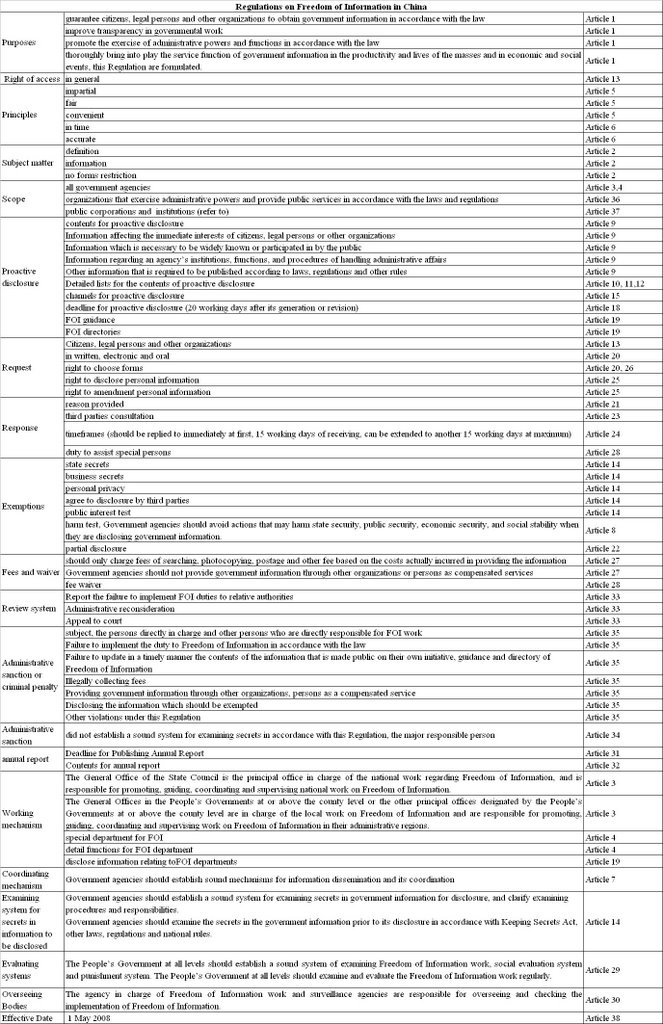
The Regulations require the government agency to publish an FOI annual report before 31 March of each year (Article 31). The annual report should include particulars of proactive disclosure, requests received, granted, refused, appealed, fees charged and waived, and problems confronted and recommendations for reform (Article 32). An FOI annual report is an important promotional measure, and can help us obtain a relatively whole picture of the use of FOI legislation in China.